
Architecting Multi-Tenant SaaS Databases for Global Scale
A practical architecture guide to building secure, scalable, and globally distributed data platforms for enterprise SaaS operations.
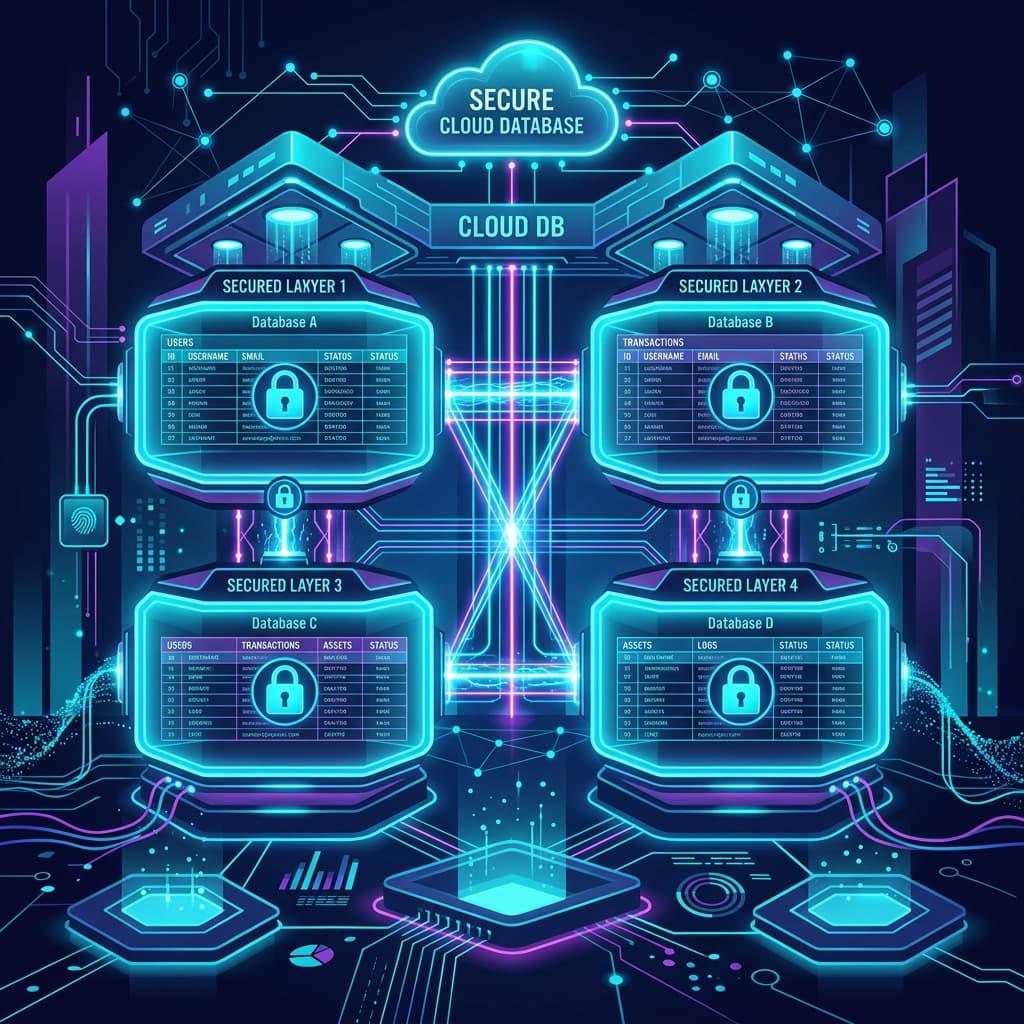
Multi-tenant database architecture is the foundation on which a global software-as-a-service platform either compounds efficiently or accumulates operational risk. The design must let thousands of organizations share a platform without sharing trust boundaries, performance failures, regulatory exposure, or deployment bottlenecks.
For enterprise ERP, CRM, AI, and integration workloads, this is especially demanding. A financial posting in an ERP system requires strong transactional guarantees. A CRM search must remain responsive during campaign peaks. AI workloads may scan large document collections, while integration services can generate bursty event traffic. The database architecture must support all four without allowing one tenant's behavior to affect another tenant's security or service level.
This insight presents the principal tenancy models, scaling and distribution strategies, security controls, and operating practices that CTOs and architects should evaluate before committing to a global SaaS data platform.
Architecture principle
Treat tenancy as a platform capability, not a column added late in development. Tenant identity must influence authentication, authorization, data access, routing, observability, encryption, provisioning, backup, and deletion from the first design review.
Why Multi-Tenant Architecture Is a Strategic Decision
Multi-tenancy allows a provider to operate a common product and control plane for many customers. Done well, it improves infrastructure utilization, accelerates releases, centralizes security controls, and makes automation economical. Done poorly, it creates systemic risk: a faulty query can expose another customer's records, a noisy workload can exhaust shared resources, or a global replication policy can violate local data-residency law.
The core challenge is balancing four competing objectives:
- Isolation: Every request, query, cache entry, event, backup, and diagnostic record must remain within its authorized tenant boundary.
- Elasticity: Capacity must expand across compute nodes, storage partitions, and regions without a disruptive re-platforming program.
- Operability: Schema changes, backups, incident response, and tenant lifecycle operations must remain manageable at thousands of tenants.
- Compliance: Data location, retention, encryption, access evidence, and deletion must be demonstrable to auditors and customers.
There is no universally correct topology. The right answer depends on customer size, regulatory obligations, workload shape, recovery objectives, unit economics, and the operational maturity of the engineering organization.
Core Multi-Tenancy Patterns
Shared Database, Shared Schema
All tenants use the same tables, and every tenant-owned row includes an immutable tenant_id. This model produces the highest resource utilization and the simplest fleet-wide schema deployment.
Advantages: low cost per tenant, efficient connection pooling, straightforward analytics, and one migration target per shard. Trade-offs: the largest blast radius, greater noisy-neighbor risk, difficult tenant-level restore, and a strict dependence on correctly enforced row-level isolation.
This pattern fits high-volume SaaS products with many small or medium tenants when the database engine supports row-level security and the application has mature tenancy testing.
Shared Database, Separate Schema
Tenants share a database instance but receive separate namespaces containing the same table structures. Logical boundaries are clearer, and tenant-specific export or restore is easier than in a shared schema.
Advantages: improved logical isolation, easier per-tenant maintenance, and limited customization options. Trade-offs: schema counts can become an operational ceiling; connection search paths, migrations, and metadata catalogs grow more complex; and compute remains shared.
This model can work for hundreds of enterprise tenants, but it becomes cumbersome when every release must migrate tens of thousands of schemas.
Separate Database on Shared Infrastructure
Each tenant receives a dedicated database while database servers or managed clusters are shared. Tenant placement is managed through a catalog that maps tenant identity to a database endpoint.
Advantages: strong logical isolation, independent backup and restore, clearer performance accounting, and easier tenant movement. Trade-offs: larger connection fleets, higher baseline cost, migration orchestration across many databases, and more complex capacity management.
This is often a strong default for regulated mid-market and enterprise SaaS because it creates a useful isolation boundary without requiring dedicated hardware for every customer.
Separate Database and Dedicated Infrastructure
Each tenant receives a dedicated database cluster or isolated cloud account/subscription. It provides the strongest operational and compliance boundary.
Advantages: maximum isolation, tenant-specific keys and maintenance windows, predictable performance, and simpler evidence for strict regulatory controls. Trade-offs: the highest cost, slower provisioning, fragmented capacity, and significant fleet-management overhead.
This pattern is appropriate for strategic customers, sovereign deployments, unusually large workloads, or contracts that mandate physical or account-level separation.
| Pattern | Isolation | Cost efficiency | Fleet complexity | Tenant restore | Typical fit | | :--- | :--- | :--- | :--- | :--- | :--- | | Shared database, shared schema | Logical row | Highest | Low initially | Difficult | Many smaller tenants | | Shared database, separate schema | Logical namespace | High | Medium to high | Moderate | Moderate enterprise fleet | | Separate database, shared infrastructure | Database boundary | Moderate | High | Straightforward | Regulated B2B SaaS | | Separate database and infrastructure | Physical/account boundary | Lowest | Highest | Straightforward | Sovereign or strategic tenants |
Most global platforms ultimately use a hybrid model: pooled shared storage for standard tenants, dedicated databases for premium or regulated tenants, and a common control plane for identity, provisioning, policy, billing, and routing.
[Diagram placeholder: Hybrid tenant placement architecture]

Global request -> Tenant-aware gateway -> Tenant catalog
                                      |-> Shared shard A (tenants 1..N)
                                      |-> Shared shard B (tenants N..M)
                                      |-> Dedicated database (regulated tenant)
                                      `-> Sovereign regional deployment
Scaling Beyond a Single Database
Horizontal and Vertical Scaling
Vertical scaling—adding CPU, memory, IOPS, or storage—buys time and is operationally simple. It is valuable for predictable growth, but it has a hard ceiling and can increase the impact of a single failure. Use it as a controlled optimization, not the long-term global scaling strategy.
Horizontal scaling distributes tenants or data across multiple database nodes. The cleanest boundary is usually the tenant: all transactional data for a tenant remains on one shard, avoiding cross-shard joins and distributed transactions. A tenant catalog resolves each authenticated tenant to its current shard and region.
Sharding Strategies
Hash-based sharding distributes tenants evenly and reduces hotspots, but tenant movement and regional placement require an indirection layer. Range-based sharding is operationally simple but can create uneven growth. Geographic sharding supports residency and latency goals, while tier-based sharding separates high-volume customers from the shared pool.
A robust strategy combines geography, service tier, and a stable hash. Design for tenant relocation from the beginning: change-data capture, dual writes or replication, consistency validation, cutover, and rollback should be automated workflows rather than emergency projects.
Avoid premature entity sharding
Sharding one tenant's ERP ledger, CRM accounts, or workflow state across unrelated partitions introduces distributed transactions and complicated recovery semantics. Keep a tenant colocated until measured scale requires entity-level partitioning.
Replication and Read/Write Separation
Send authoritative writes to a regional primary and eligible reads to replicas. Reporting, search indexing, AI feature extraction, and dashboard queries are strong candidates for replicas or specialized read models. Financial balances, inventory availability, authorization decisions, and immediately-after-write screens often require primary reads or explicit session consistency.
Replication lag must be treated as a product behavior, not merely an infrastructure metric. APIs should define their consistency guarantees, and critical workflows should never silently consume stale state.
Data Isolation and Security by Design
Application filters alone are not a sufficient security boundary. Use defense in depth so that a single defect cannot cross tenants.
At the edge, derive tenant identity from verified authentication claims rather than user-supplied headers. In the service layer, pass a typed tenant context through every operation. In the database, enforce row-level security or dedicated credentials and schemas. In asynchronous processing, include signed tenant context in event envelopes and validate it again at consumption.
-- PostgreSQL example: enforce tenant isolation in the database.
ALTER TABLE customer_accounts ENABLE ROW LEVEL SECURITY;
ALTER TABLE customer_accounts FORCE ROW LEVEL SECURITY;

CREATE POLICY tenant_accounts_policy ON customer_accounts
  USING (tenant_id = current_setting('app.current_tenant_id')::uuid)
  WITH CHECK (tenant_id = current_setting('app.current_tenant_id')::uuid);
Important controls include:
- Encryption in transit: Require modern TLS for clients, services, replication, administrative access, and backup transfer.
- Encryption at rest: Encrypt databases, snapshots, logs, queues, and caches. Use tenant-specific keys when contractual or regulatory risk justifies the operational cost.
- Role-based access control: Separate application, migration, support, analytics, and break-glass roles. Apply least privilege and time-bound elevation.
- Secret management: Rotate credentials centrally and prefer workload identity or short-lived tokens over embedded passwords.
- Auditability: Record tenant, actor, purpose, action, resource, outcome, region, and correlation ID in tamper-resistant logs.
- Safe support tooling: Require explicit tenant selection, visible context, approval for sensitive operations, and complete audit trails.
For GDPR, document the lawful basis, data locations, retention periods, subprocessors, portability, and verified erasure path. SOC 2 evidence should show that controls operate continuously, not merely that policies exist. ISO 27001 requires an organization-wide information security management system with risk treatment, ownership, and continual improvement. These frameworks shape architecture and operations, but certification scope and legal obligations should be validated with qualified compliance and legal teams.
Performance Optimization for Mixed Enterprise Workloads
Index for Tenant-Scoped Access
Most indexes in a shared-schema model should begin with tenant_id, followed by the fields used for filtering or ordering. A CRM query may use (tenant_id, account_status, updated_at), while an ERP posting lookup may use (tenant_id, fiscal_year, document_number). Enforce tenant-scoped uniqueness with composite constraints rather than global identifiers unless global uniqueness is intentional.
Review query plans against realistic tenant distributions. Global test averages hide the conditions that matter: one large tenant, skewed status fields, a month-end close, or an AI ingestion burst.
Control Connections and Workload Classes
Use transaction-aware connection pooling and cap pools per service, shard, and priority class. Autoscaling application instances without pool limits can overwhelm a healthy database with connection storms. Reserve capacity for critical writes and administrative recovery.
Separate operational transactions from analytics. Export changes through an outbox and change-data-capture pipeline into a warehouse, lakehouse, search index, or vector store. Do not let unbounded reporting or AI retrieval queries compete with ERP posting and CRM transaction traffic.
Cache With Tenant-Safe Keys
Every cache key must include tenant identity, environment, schema version, and resource identity where applicable. Define invalidation behavior, maximum staleness, and whether the cached value contains regulated data. Authorization decisions and mutable financial state demand especially conservative caching.
Measure Tenant-Level Service Health
Monitor p50, p95, and p99 latency; transaction rate; lock waits; deadlocks; connection saturation; cache hit rate; replication lag; storage growth; backup success; restore duration; and per-shard error budgets. Add tenant-aware dimensions carefully: retain enough detail to detect noisy neighbors without placing sensitive identifiers into high-cardinality telemetry.
Illustrative workload isolation priority (relative score)
The values above illustrate scheduling priority, not benchmark results. Each platform should derive workload classes and service objectives from its own business processes.
Designing for Global Distribution
Establish a Regional Cell Architecture
A global control plane can manage tenant identity, placement policy, product configuration, and deployment coordination. Regional data-plane cells serve application traffic and own the databases, caches, queues, and encryption boundaries for tenants assigned to that region. Cells constrain failures and make capacity expansion repeatable.
[Diagram placeholder: Global SaaS regional-cell topology]

                    Global control plane
              identity | policy | tenant catalog
                         /      |      \
             Americas cell  EU cell  APAC cell
              app + data    app + data  app + data
                   |            |           |
              local primary  local primary  local primary
              + replicas     + replicas     + replicas
Make Data Residency Explicit
Store a tenant's approved home region and data classification as policy, not informal configuration. Routing, backups, disaster recovery copies, logs, support access, analytics exports, and AI processing must all honor that policy. Metadata can also be regulated; do not assume a global control plane may store unrestricted customer details.
Optimize Latency Without Weakening Correctness
Route users to the nearest permitted cell, use content delivery networks for static assets, cache reference data, and colocate application compute with the primary database. Avoid synchronous cross-region calls in request paths. Exchange domain events asynchronously and design consumers to be idempotent.
Active-passive replication is usually simpler for transactional systems and offers clear write ownership. Active-active systems reduce local write latency but introduce conflict resolution, clock, ordering, and uniqueness challenges. Use active-active only when the business requirement justifies those semantics and every conflicting domain operation has a deterministic resolution policy.
Define recovery objectives per workload. A general content service, CRM interaction, ERP ledger, and integration event stream may require different recovery point objectives (RPOs) and recovery time objectives (RTOs). Test regional failover under load and verify that DNS, secrets, queues, caches, and dependent integrations recover—not only the database.
Best-Practice Operating Model
- Select tenancy by policy. Use a decision matrix covering regulation, workload, size, recovery, customization, and commercial tier. Support promotion from pooled to dedicated placement.
- Automate onboarding. Provision tenant identity, placement, schema, keys, quotas, seed data, monitoring, and audit records through an idempotent workflow with compensating rollback.
- Version schemas safely. Favor backward-compatible expand-and-contract migrations. Track version by shard or database, throttle rollouts, validate results, and preserve a tested rollback path.
- Build tenant-aware backup and recovery. Encrypt immutable backups, isolate credentials, test full and tenant-level restores, and measure achieved RPO/RTO. A successful backup job is not proof of recoverability.
- Design deletion as a workflow. Discover and erase tenant data across primaries, replicas, caches, search indexes, event stores, analytics platforms, AI corpora, and backups according to retention policy.
- Apply quotas and admission control. Limit queries, connections, jobs, storage, and integration throughput per tenant and workload class. Provide transparent escalation paths for planned peaks.
- Continuously verify isolation. Run negative authorization tests, cross-tenant property tests, policy checks, penetration tests, and restore exercises in the delivery pipeline and production assurance program.
- Automate placement and rebalancing. Forecast shard saturation, detect hotspots, recommend moves, and execute tenant relocation through observable, reversible workflows.
- Use the transactional outbox. Commit business state and an event record atomically, then publish asynchronously to BrainConnect-style integration flows, analytics, and AI services.
- Operate with per-tenant evidence. Make service health, data location, key ownership, backup status, and administrative access explainable to internal teams and enterprise customers.
“A globally scalable SaaS database is not one enormous cluster. It is a policy-driven system of bounded cells, explicit tenant placement, automated lifecycle operations, and independently verifiable security controls.
”
A Practical Architecture Decision Checklist
Before approving a production design, ask:
- Can every data access path prove the tenant boundary independently of application convention?
- Can a high-volume tenant be moved to dedicated capacity without changing its public API?
- Are consistency guarantees explicit for replicas, caches, events, and disaster recovery?
- Do residency controls cover logs, backups, analytics, support, and AI processing as well as primary records?
- Can the team deploy a schema change safely across the entire fleet and identify incomplete migrations?
- Has tenant-level restore and complete deletion been demonstrated in a realistic environment?
- Can operations detect and contain a noisy tenant before other customers breach their service objectives?
- Are cost, capacity, reliability, and security visible by tenant, shard, workload, and region?
If any answer depends on manual knowledge or a developer remembering a convention, the architecture is not yet ready for global enterprise scale.
Conclusion
A well-architected multi-tenant database platform gives an enterprise SaaS business more than lower infrastructure cost. It creates trustworthy isolation, predictable performance, regional resilience, auditable compliance, rapid tenant provisioning, and a controlled path from early product growth to worldwide operations.
The strongest designs separate global policy from regional execution, choose isolation based on risk, keep transactional tenant data colocated, and automate every lifecycle operation. They also recognize that ERP, CRM, AI, and integration workloads have different consistency and performance needs while still requiring one coherent security model.
Brainzon brings these principles together across BrainERP, BrainCRM, BrainAI, and BrainConnect, helping technology leaders build cloud-first platforms that connect enterprise operations, customer intelligence, responsible AI, and global integrations on a secure data foundation.
Recommended Related Insights

Modernizing Legacy ERP Systems for the Cloud Era
A risk-managed roadmap for opening, decomposing, and evolving mission-critical ERP capabilities without disrupting business continuity.
Enhancing Customer 360 Portals with Sentiment Analysis
How to combine governed customer data and responsible language AI to prioritize service, detect account risk, and support more informed human decisions.