
Enhancing Customer 360 Portals with Sentiment Analysis
How to combine governed customer data and responsible language AI to prioritize service, detect account risk, and support more informed human decisions.
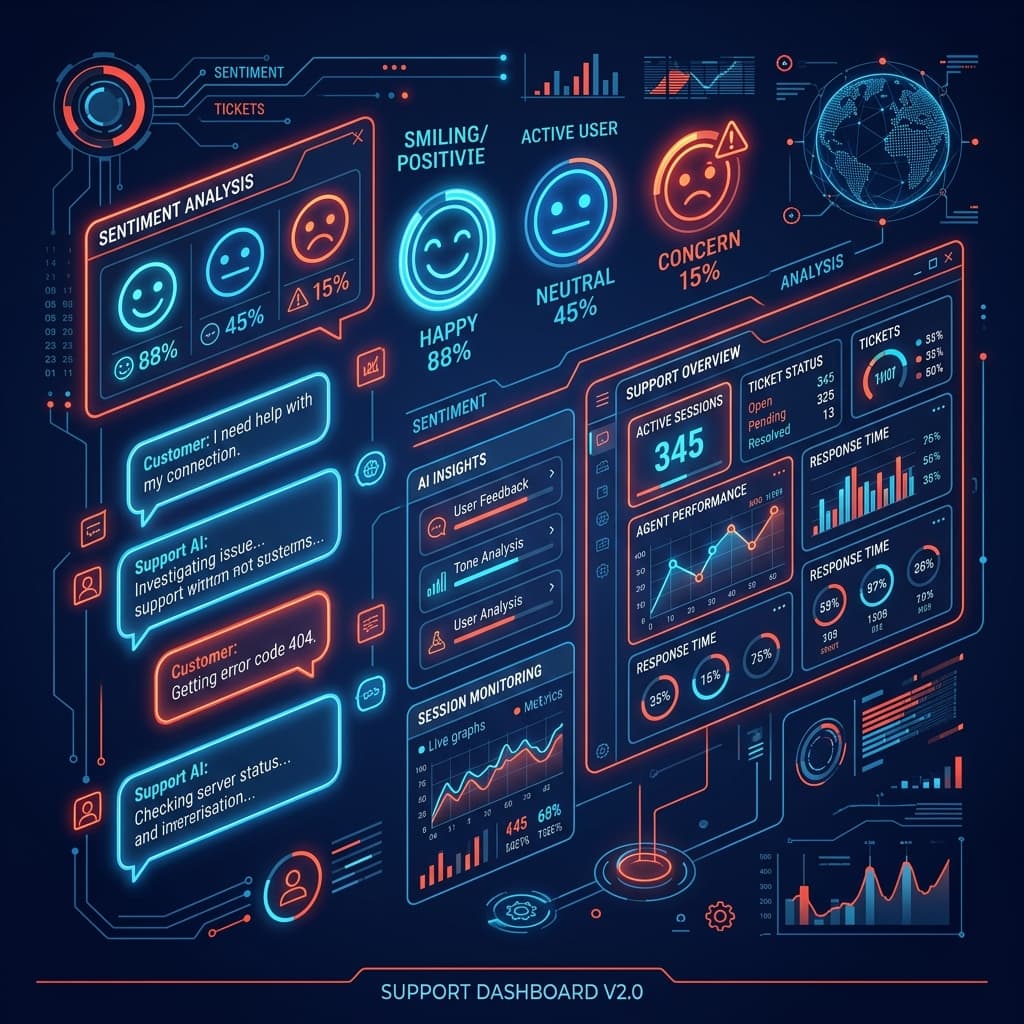
A Customer 360 portal is valuable because it gives authorized teams a coherent view of an account: identity, products, orders, cases, contracts, service levels, interactions, and consent. Sentiment analysis can add another signal—how language may indicate satisfaction, frustration, urgency, or uncertainty—but it must not be mistaken for objective knowledge of a person's emotions.
For enterprise service organizations, the opportunity is to combine language signals with operational context. A mildly negative message from a strategic customer with repeated outages and an approaching renewal may require faster intervention than strongly negative language in an already resolved low-impact case. Effective prioritization therefore blends AI inference, CRM facts, service policy, and human judgment.
Build Customer 360 Before Adding AI
Sentiment cannot repair fragmented identity or inconsistent case data. Establish stable customer, account, contact, interaction, case, contract, and consent identifiers first. Define which system owns each fact and how records are matched across email, chat, voice transcripts, portals, ERP, product telemetry, and external channels.
Identity resolution should be confidence-based. Deterministic matches—verified email, customer ID, authenticated session—are stronger than name similarity. Ambiguous matches should not silently merge profiles, especially across legal entities or household members.
Sentiment is one feature, not the decision
Prioritization should combine sentiment confidence, case severity, customer impact, SLA position, recurrence, account value, vulnerability indicators, and recent history. Human agents remain accountable for consequential actions.
Reference Architecture
Ingestion adapters receive interactions from approved channels. A privacy gateway validates purpose, consent, retention, and residency. Processing services redact unnecessary sensitive data, detect language, and classify sentiment, urgency, intent, and topic. The result—not unrestricted raw content—is attached to the authorized Customer 360 profile with model and policy metadata.
[Diagram placeholder: Governed Customer 360 sentiment pipeline]

Email | Chat | Voice transcript | Portal
                  |
       BrainConnect ingestion adapters
                  |
   Consent + privacy + data minimization gateway
                  |
      Language AI classification service
        | sentiment | urgency | topic |
                  |
     BrainCRM Customer 360 and case routing
                  |
        Agent review -> action -> feedback
Use asynchronous processing for enrichment so the customer interaction channel remains available if an AI provider is slow. Safety-critical escalation terms may also use deterministic rules at ingestion, with AI as supporting context.
Model the Signal Carefully
A binary positive/negative label is rarely sufficient. Capture a calibrated score or class, confidence, detected language, relevant topic, urgency, model version, timestamp, and the interaction span that influenced the result. Keep uncertainty visible.
Sentiment is contextual. Sarcasm, regional phrasing, mixed language, technical terminology, quoted text, and speech transcription errors can distort results. Enterprise models should be evaluated by language, channel, customer segment, case type, and message length—not only by one aggregate accuracy number.
interface InteractionInsight {
  interactionId: string;
  accountId: string;
  sentiment: "negative" | "neutral" | "positive" | "mixed";
  confidence: number;
  urgency: "standard" | "elevated" | "critical";
  topics: string[];
  language: string;
  modelVersion: string;
  policyVersion: string;
  evaluatedAt: string;
}
Route Cases With Policy, Not a Magic Threshold
Create an explainable prioritization policy. A high-risk route might require negative sentiment and one or more business conditions: an SLA nearing breach, repeated contacts, a production outage, regulated complaint language, declining usage, or renewal risk.
Policy should specify what happens next: increase priority, notify an account owner, request supervisor review, initiate a service-recovery playbook, or ask the agent to verify context. Do not automatically cancel contracts, deny service, change pricing, or make other consequential decisions from inferred sentiment.
Illustrative signals in a service-priority score
These relative values are illustrative. Organizations should validate weights against service policy and historical outcomes, then monitor whether the policy treats customer groups consistently.
Privacy, Security, and Responsible AI
Customer communications may contain personal, financial, health, employment, or authentication data. Minimize collection, redact unnecessary sensitive values before inference, encrypt data, and restrict access by role and purpose. Define retention separately for source content, transcripts, derived features, model logs, and agent notes.
For external AI services, evaluate processing locations, subprocessors, retention, model-training terms, security controls, and deletion commitments. Regional routing must apply to inference and telemetry as well as the CRM record.
Give agents a way to correct or dismiss an inference. Preserve that feedback without turning it into an unreviewed training label. Monitor false escalation and missed escalation by language and segment, and investigate material differences. Avoid displaying reductive labels such as “angry customer” as permanent profile attributes; describe the signal as interaction-specific and time-bound.
Avoid emotion surveillance
Use language analysis to improve service response for a defined purpose. Do not infer sensitive traits, manipulate vulnerable customers, or repurpose service communications for unrelated profiling without a valid legal and ethical basis.
Create an Account-Level Trend Without Hiding Detail
One negative interaction should not permanently define account health. Aggregate recent signals with decay, channel reliability, interaction volume, issue resolution, product usage, payment status, and survey feedback. Make the underlying interactions accessible to authorized agents so they can verify why a trend changed.
Separate individual contact sentiment from account health. In B2B relationships, contacts may have different roles and experiences. A procurement concern, administrator incident, and executive renewal discussion should not collapse into one unexplained average.
Measure Outcomes, Not Model Activity
Operational measures should include time to first meaningful response, SLA attainment, repeat contact, escalation precision, resolution time, customer-reported satisfaction, complaint recurrence, retention outcomes, agent acceptance, and override reasons. Compare against a pre-deployment baseline and use controlled pilots where possible.
Model metrics such as precision, recall, calibration, language coverage, drift, and inference latency remain essential, but an accurate model can still create poor outcomes if routing is disruptive or agents do not trust it.
Implementation Roadmap
- Define purpose and governance. Identify supported decisions, prohibited uses, accountable owners, legal basis, and retention.
- Strengthen Customer 360 data. Resolve identity, ownership, consent, interaction lineage, and access control.
- Pilot one channel and workflow. Start with a well-understood case queue and run inference in shadow mode.
- Evaluate inclusively. Test languages, channels, segments, technical vocabulary, and transcription quality with domain reviewers.
- Introduce agent-assisted routing. Explain recommendations, collect corrections, and retain human control.
- Scale with monitoring. Version models and policies, watch drift and group performance, and audit downstream actions.
Executive Checklist
- Is the Customer 360 identity graph trustworthy and explainable?
- Is sentiment tied to a specific interaction and model version?
- Can agents see uncertainty and the factors behind routing?
- Are consent, residency, retention, and deletion enforced across AI processing?
- Have multilingual and segment-level errors been evaluated?
- Are consequential decisions protected by human review?
- Is success measured through service outcomes rather than alert volume?
Conclusion
Sentiment analysis can make Customer 360 portals more responsive, but only when it is treated as a governed, uncertain signal inside a broader service decision. Strong implementations begin with reliable customer data, apply privacy by design, make policy explicit, preserve human accountability, and learn from measured outcomes.
BrainCRM provides the customer and service context, BrainAI supplies governed language intelligence, BrainConnect integrates interaction channels, and BrainERP contributes commercial and operational facts where authorized. Together, they enable customer teams to act earlier without losing trust, transparency, or control.
Recommended Related Insights

Architecting Multi-Tenant SaaS Databases for Global Scale
A practical architecture guide to building secure, scalable, and globally distributed data platforms for enterprise SaaS operations.

Optimizing ERP Procurement Workflows with Real-Time Automation
How to connect demand, inventory, suppliers, controls, and intelligent forecasting to build a faster and more resilient source-to-pay operation.