
The ROI of Predictive AI in Smart Manufacturing
A practical framework for turning industrial telemetry into safer maintenance decisions, higher asset availability, and measurable operational value.
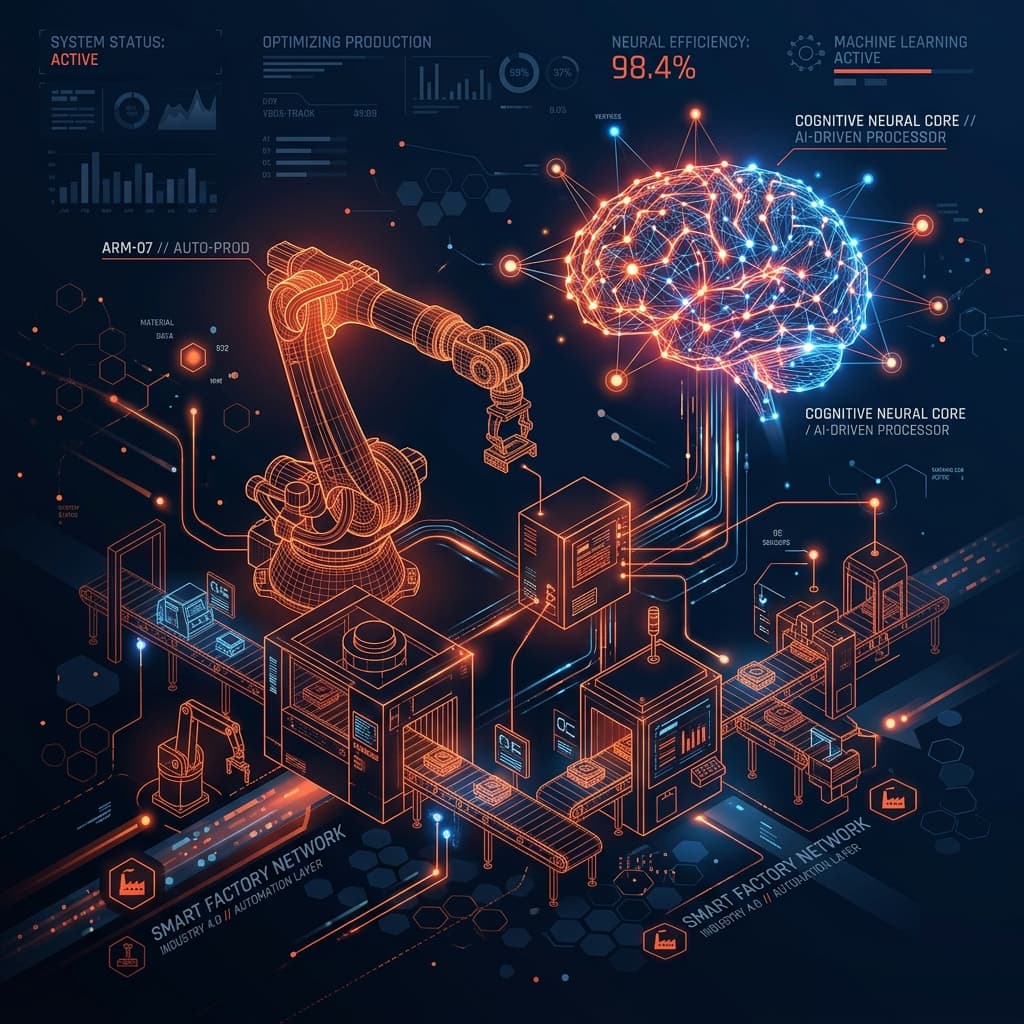
Predictive maintenance creates value when it converts machine behavior into timely, trusted action. The objective is not simply to predict a failure. It is to help maintenance teams decide what to inspect, when to intervene, which parts to reserve, and how to protect production output without creating an unmanageable volume of false alarms.
For manufacturing leaders, this makes predictive AI an operating-model initiative rather than a standalone data-science project. Sensors, edge computing, cloud analytics, maintenance execution, ERP inventory, procurement, and human safety processes must work as one governed system.
From Scheduled Maintenance to Condition-Based Decisions
Reactive maintenance waits for failure and absorbs the resulting downtime, expedited parts, safety exposure, and production disruption. Preventive maintenance improves reliability by servicing assets on a fixed schedule, but it can replace healthy components and still miss failures between intervals. Predictive maintenance estimates asset condition and failure risk from observed behavior, enabling teams to intervene when evidence justifies it.
The strongest programs use all three approaches according to asset criticality. Low-cost, non-critical assets may remain reactive. Regulated or safety-critical equipment may retain mandated preventive schedules. High-value bottleneck assets are often the best predictive-maintenance candidates.
Start with the operational decision
Define the maintenance decision, intervention lead time, accountable owner, and acceptable false-alarm rate before selecting sensors or models. A technically accurate alert has no value if it arrives too late to source a part or too early to be trusted.
The Industrial Data Architecture
Common signals include vibration, temperature, pressure, current, acoustic emissions, lubricant condition, throughput, fault codes, and operator observations. These signals become useful only when they are aligned with asset identity, operating state, maintenance history, production schedule, and environmental context.
At the edge, gateways normalize protocols, timestamp measurements, validate quality, and compute compact features. Local inference supports low-latency safety or shutdown decisions and keeps operations resilient during network interruptions. The cloud aggregates longer histories, trains models, compares fleets, and coordinates enterprise workflows.
[Diagram placeholder: Edge-to-cloud predictive maintenance architecture]

Machine sensors -> Edge gateway -> Local rules/inference
                         |                |-> Immediate safe response
                         `-> Event stream -> Cloud feature platform
                                              |-> Model inference
                                              |-> BrainAI monitoring
                                              `-> BrainERP work order + parts
Use an industrial namespace or asset hierarchy to connect every reading to plant, line, machine, subsystem, and component. Without stable asset identity, maintenance history and telemetry cannot be combined reliably.
Choosing the Right Analytical Method
Threshold and rules-based monitoring is transparent and effective for known operating limits. Statistical process control detects drift from a stable baseline. Anomaly detection helps when failure examples are rare, but it requires operating-context awareness to avoid flagging normal mode changes. Supervised classification estimates known failure modes when labeled history exists. Remaining useful life models forecast time to intervention but require strong degradation histories and careful uncertainty communication.
A production solution often combines these methods. Rules protect hard safety limits, anomaly models identify unfamiliar behavior, and failure-mode models prioritize known risks. The system should report confidence, relevant signals, and recommended inspection—not only a score.
# Conceptual decision flow; production systems require validation and safeguards.
features = feature_pipeline.transform(sensor_window, operating_context)
risk = failure_model.predict_proba(features)

if risk.confidence >= policy.minimum_confidence:
    recommendation = maintenance_policy.evaluate(
        risk=risk,
        asset_criticality=asset.criticality,
        production_window=schedule.next_available_window,
    )
    publish_recommendation(recommendation)
Building a Defensible ROI Model
The business case should compare a measured baseline with the expected and realized effects of the program. Include:
- avoided downtime hours multiplied by the contribution margin or verified cost per hour;
- reduction in emergency labor, expedited freight, and secondary damage;
- changes in planned-maintenance duration and schedule adherence;
- spare-parts inventory, obsolescence, and working-capital effects;
- sensor, connectivity, cloud, integration, model operations, and change-management costs;
- the cost of false positives, missed failures, and unnecessary inspections.
Use a range rather than a single-point forecast. Separate gross avoided loss from cashable savings and capacity value; not every avoided hour immediately becomes revenue.
Illustrative value contribution by outcome (relative index)
These values illustrate how an ROI model may be structured; they are not Brainzon customer benchmarks. Every business case should use plant-specific baselines and finance-approved assumptions.
Connecting AI to ERP Execution
Predictions produce value only when they enter the maintenance system of record. A governed workflow should:
- create a recommendation with asset, failure mode, confidence, evidence, and urgency;
- check production plans and approved maintenance windows;
- verify technician skills, tools, and safety procedures;
- reserve existing parts or initiate a procurement request;
- require human approval according to risk and confidence;
- create and track the BrainERP work order;
- capture findings, replaced components, root cause, and outcome as model feedback.
BrainConnect-style integration can bridge plant historians, SCADA/MES platforms, BrainAI inference, BrainERP maintenance and inventory, supplier systems, and operational notifications without allowing AI services to write directly into safety-critical control networks.
Responsible AI and Operational Safety
Predictive maintenance models drift when machines age, products change, sensors are replaced, or operating regimes shift. Monitor data completeness, sensor calibration, feature distributions, alert rates, precision, lead time, and outcome by asset class. Version data, features, models, thresholds, and maintenance policies together.
Maintain human accountability for safety-critical decisions. Provide explanations in engineering terms, preserve override reasons, and use fallback rules when inference is unavailable. Segment operational technology networks, authenticate devices, encrypt transport, sign software updates, and restrict commands from cloud systems.
AI must not bypass plant safety controls
Predictive recommendations should support approved maintenance and safety processes. They should not directly override protective systems, interlocks, or operator authority without a separately validated control-system design.
A Phased Implementation Roadmap
1. Select a valuable pilot
Choose a constrained asset family with high downtime impact, accessible data, repeatable failure modes, and engaged maintenance experts. Establish baseline measures before deployment.
2. Build the data foundation
Create the asset hierarchy, validate sensor quality, connect work-order history, standardize failure codes, and define retention and cybersecurity boundaries.
3. Run in advisory mode
Deliver alerts without automated work orders. Measure precision, useful lead time, technician acceptance, and operational impact. Review false alarms with domain experts.
4. Integrate execution
Connect approved recommendations to work orders, spare-parts availability, procurement, and production planning. Introduce policy-based approval and escalation.
5. Scale as a product
Templatize asset onboarding, monitor model health, automate retraining gates, and manage versions across sites. Compare plants only after definitions and baselines are standardized.
Executive Checklist
- Is the targeted asset operationally critical and economically material?
- Is there enough intervention lead time to change the outcome?
- Are sensor quality, asset identity, maintenance history, and failure labels trustworthy?
- Are false-positive and missed-failure costs explicitly modeled?
- Does every recommendation have an owner and executable workflow?
- Can the organization monitor drift and safely fall back when AI is unavailable?
- Has Finance approved the baseline and benefit-calculation method?
Conclusion
Predictive AI can move manufacturing from calendar-based intervention to evidence-based reliability. Its return comes from the complete loop: trustworthy industrial data, context-aware models, responsible human decisions, ERP execution, integration automation, and measured operational outcomes.
Brainzon combines BrainAI for governed intelligence, BrainERP for maintenance, inventory, and procurement execution, and BrainConnect for secure industrial integration. Together, these capabilities help manufacturers scale predictive operations without disconnecting AI from the systems and people responsible for production.
Recommended Related Insights
Optimizing ERP Procurement Workflows with Real-Time Automation
How to connect demand, inventory, suppliers, controls, and intelligent forecasting to build a faster and more resilient source-to-pay operation.

Architecting Multi-Tenant SaaS Databases for Global Scale
A practical architecture guide to building secure, scalable, and globally distributed data platforms for enterprise SaaS operations.